A Perfect Storm – Murray White
Those familiar with South Australia’s Goyder Line will not be surprised that Ikara-Flinders Ranges lie largely on the northern side of this pivotal boundary; an area whose climatic destiny has been declared as “liable to drought” since 1865. Now, while the location of this line (drawn as a guide for pioneering pastoralists) has become considerably more doubtful as a consequence of climate change, there remains nonetheless an obvious transition into the arid areas of South Australia – the driest part of the driest state in the country.
But very occasionally, Nature provides relief to this parched landscape, drenching its sunburnt skin as the heavens open to cool the air, purge the fallen and once again push silty water down ancient riverbeds. The first half of this year has seen such a reprieve, and to stunned visitors the environmental transition is nothing short of remarkable. Grasses rise from the dust, seedlings take root among the gibbers, and one can sense the euphoria of life that only water can bring.
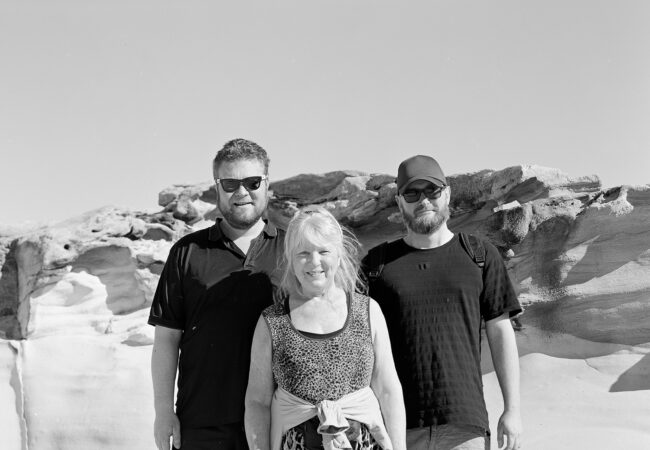
My wife and I made a trip to Ikara-Flinders Ranges just after the last rain event to experience something of this dramatic transition, and in my case, to hopefully capture a piece of this resilient country on film. Timing was important because we needed to avoid the inevitable road closures but wished to be there as soon as possible when access was permitted. To see water flowing strongly across such a harsh terrain is something quite mesmerising. I can only imagine what transpires when flooding is at its peak, and massive piles of debris are washed into rocky chokes and around the tortured buttresses of centuries-old redgums.
Our entry into the ranges began on the climb to Horrocks Pass – a winding vehicle journey through country now so lush it was difficult to remember just how denuded this terrain often is. The potential for colour photography was amazing with bands of greenery defining successive rounded hills of chocolate coloured rock, all capped by a jagged tree line piercing the blue sky above. I was here to capture some of this grandeur on B&W film though, and subject selection required a slightly different mind-set. I found more of interest deeper into the ranges, where the area’s tone and texture rich geology has been exposed and manipulated by the forces of Nature over millennia.
Camera walks were frequent as we toured the gorges and scenic drives, stopping frequently to get a sense of the scale and influence of the remnant floodwater, although I have to confess that in many cases just being amongst the landscape was satisfaction enough. There is something to be said for that primal connection with Nature, where looking and walking and touching the environment fills a need that we often don’t know we are missing.
I would sometimes meet a subject that felt more special in a visual sense and would try to get a handle on how best to convey that experience. Sometimes that connection while under the dark cloth resulted in an image of personal value, but on other occasions I didn’t even set up the tripod. Indeed, there were many instances where I spent considerable time looking at a subject, exploring its structure and relationship to the setting, but never quite found a ‘perfect’ way to express that interaction, and chose to move on.
I have come to understand that my inability to make a photograph of a particular subject is in no way reflective of the subject’s intrinsic value; it is just recognition that I don’t always connect on that level at that time. A potential subject is just that – it is a starting point on a much more organic process of assessing the lighting, the network of supporting features and even the perceived interaction between subject and setting. I think when connection is made in a visual sense, I am instinctively aware of that moment, and no amount of forcing the process could (or should) be applied to reach that point.
For me, the most photographically productive times occurred in the early morning, when the wind was subdued and the lighting diffused. Even the progression of time seems to slow down as the day begins, and I found it easy to enter a natural setting as if responding to an invitation rather than needing to mount an expedition. Bathed in a quieter light, environmental entities can lose their formal identity to be seen more as partners and contributors to the broader landscape. I think that each player, however seemingly insignificant, has a role to play in the holistic appreciation of Nature, and it is by trying to identify their purpose that helps me apply a more curious slant to the visual possibilities.
As one of Australia’s most easily accessible entry points to its arid areas, Ikara-Flinders Ranges is a popular destination, with tourist infrastructure and various accommodation possibilities. Sealed roads encircle the most dramatic of range country and the smaller outback towns are a delight to visit. The Prairie Hotel at Parachilna lives up to its somewhat evocative name on the flat western side of the ranges, while those ever-optimistic mining folk of the 19th century even saw a need for the township of Blinman (pop. 43) to overflow into Blinman North.
In drier weather most of the minor unsealed roads are accessible to conventional vehicles and there are attractive camping opportunities spread across the ranges. Free camping is available in Parachilna Gorge, serviced camping at a few of the towns, and plenty of national park options. Several pastoral stations offer accommodation and activities as well. Defined walks vary from short to the (considerably) longer Heysen Trail.

Every major flood sees enormous quantities of debris washed down the swollen riverbeds, only to be trapped by some bottleneck in the waterway. This sizeable River Redgum appears resolute under the relentless onslaught – its ancient skin will simply carry another scar, one more fold in the healing process, one more reason to push its roots deeper into the rock.

The geological response to daily and cyclical weather and temperature influences is particularly evident in the gorge system dissecting Ikara-Flinders Ranges. Similar changes (perhaps even on a grander scale) can be found at Vulkathunha-Gammon Ranges to the north of here, where a sense of ‘the outback’ is even more pronounced. This particular scene in Brachina Gorge was framed to illustrate the transition that time will ultimately bring to all things – living or otherwise.

Textures and tonal complexity are everywhere to be found in Ikara-Flinders Ranges, making explorations with B&W film a rewarding experience. In this particular print, sheets of fragmented rock have formed a spillway where mineralised or nutrient-rich water has recently flowed. On the one hand this randomness of Nature is expected, but on the other there is an intriguing sense of unification to be seen in otherwise unrelated entities, a consistency of line, of form, perhaps even of purpose.

Sustained rain brought welcome water not only to the major creeks and floodplains, but to the broader landmass as a whole, where its mercurial tentacles found their way into every crevice of the landscape. This contorted redgum became part of the waterway itself as it lay on a bed of rock, almost encircling the place of its birth. I found locations such as this to be quite spiritual; an atmosphere magnified through the prism of visual connection on the ground glass and the background sound of trickling water.

In some cases remnant pools of water became mirrors of the surrounding landscape and a mechanism by which various structures could take on geometric attributes. This outcrop of slate sheet displayed, I think, even more three-dimensional qualities when captured in partner with its reflection. When making images that include reflection, I typically don’t focus wholly on the phenomenon itself, which is partly why I included additional elements in the top quarter of the print.