
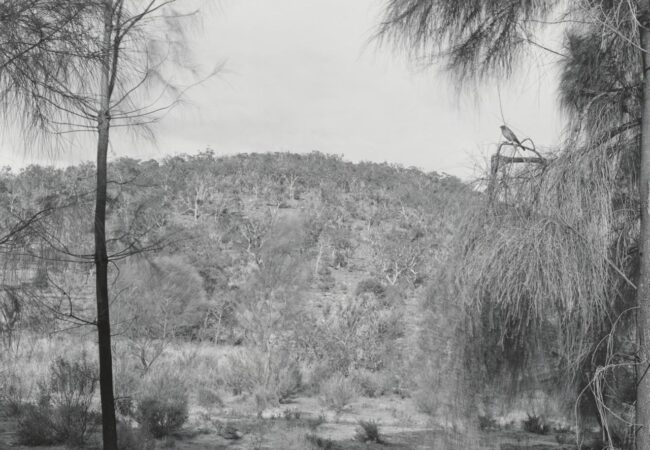
Photograph above: Ian Lobb. Untitled. From the Black Range series…

The Photograph Considered number fifty three – Murray White
Into The Void
Without exception, those photographs of most value to me have been ones made in unexpected circumstances. I rarely set out to capture a particular subject in a particular way at a time of my choosing; at least I don’t set out with a master plan, I’m more likely to react to circumstance rather than set the agenda. It’s not that I don’t aspire to achieve the quality and technical standards of a studio-type image, it’s just that for me the magic of photography is keenly felt in a more organic exploration of the environment itself.
And so it was on a recent trip to Queensland. My loose ‘plan’ was to revisit the Channel Country after rain, followed by a few of my favourite destinations in the state’s sandbelt area (Carnarvon Gorge, White Mountains, Porcupine Gorge etc). This particular image was made at Cape Upstart – not exactly a natural geographic stepping stone in the State’s central region, but hey, I’ve never really got my head around Google Maps, and back in the day I’ve travelled some of Victoria’s High country fire trails with track sketches scribbled on the back of a tissue box. It’s always about the journey.
Anyway Cape Upstart is a lovely destination, with only limited tourist access. We ventured toward the coast to find a small beach-side camp tucked away along an almost deserted stretch of tropical beach. My wife and I spent some time here wandering the rippled sand, which stretched for hundreds of metres from the shoreline at low tide – such is the ocean’s reach along this part of the world. With undulating sand bars, pieces of driftwood and the distant headland crowning the sparkling water, it appeared to me that there would be much to investigate photographically the next morning.
Of course the next morning brought its own set of influences. Showers had developed overnight, the breeze had picked up, and the now grey skies merged into a murkier seascape. On the plus side, the diffused lighting could be ideal for more intricate subjects, but where to point the camera?
I wandered back inland away from the exposed coast and followed the road aimlessly looking for inspiration. I reached a lagoon that we had passed on the way in and now scanned the area more seriously for possibilities. Beyond the grassland I saw a number of dead trees fringing the waterway, their gnarly torsos reflected in the water. Under the blue sky yesterday the scene screamed only of unworkable contrast; today was very different.
In the process of considering how to interpret the broader view of these trees, I came to realise that some had toppled into the tinted waters – again something that I didn’t fully appreciate from our vehicle on the drive in. Time to investigate further. Access by foot onto the wetland was a little tricky, although with croaking frogs and a thick mat of cushioned grass, I chose to be especially cautious anyway…. The reward however was some beautiful shapes and intricate overlapping lines etching the waterway that weren’t evident from the road.
Quite unexpected! And quite captivating! I knew that I would probably be taking a photograph here, but which subject to choose?
That decision was partly driven by the thought that these decaying trees were simply returning to the soil that created them. It seemed curious that despite the sometimes viscous coastal storms that impact this part of Queensland, these remnant hulks appeared almost placid, predictable in layout – like a house of cards collapsing into itself. I found several arrangements that illustrated this concept, but kept returning to this particular subject. I liked the implied symmetry and the triangular architecture. There was at once a simplicity of the setting yet a complexity within the various elements.
In terms of the practical considerations, I had brought with me my Ebony SW23 view camera rather than the 4 x 5 (partly because of its capability in the wind and rain) and partly because I was still experimenting with it as a view camera system). I have modified my tripod to support an umbrella if needed (and it was today!) and the roll film camera fits well with this accessory too.
I chose a vertical composition and the standard 100mm lens for several reasons. Firstly this is my preferred combination as I feel it conveys the formality and implied life of a ‘portrait’ to a landscape capture and the standard lens effectively replicates the reality of its proportions. However in this case it was also driven by where I could stand and the achievable height I needed to ‘fill the frame’. It also allowed me to find a composition that avoided other competing structures lying nearby.
The capture was made on Ilford FP4+ and developed in Ilford LC29 at 1:29 dilution. It is combination that I have used for some years and suits my desire for fine grain in the print, and a processing regime that is compatible with our need to dispose of chemistry elsewhere. The print is a full frame enlargement onto 8 x 10 silver gelatin semigloss paper made under a multigrade head. I chose to print at grade 1 ½ with a reduced exposure to hold detail in the shadows, and maintain a lighter tone in the reflections. I gave the print a slight burn to the top, both left and right sides, to avoid the light tone bleeding fully into the print border.
Next Post: Vale: Photographer Martin Parr 1952 – 2025
Previous Post: Season’s greetings from View Camera Australia


Beautiful image Murray and thanks for taking the time to explain your thoughts.
Thanks very much Shane, a pleasure!
Murray, what a spectacular image! And your thinking process was elegantly articulated.
Peter, thankyou very much, greatly appreciated.
Fantastic Murray, very sculptural and elegantly composed. Interesting to hear some insight into your darkroom process too, thank you for sharing!
Thankyou Charles, I too find it interesting to learn how other analogue photographers work with the medium.