Treasures of The Tarkine – Murray White
Often inspiring but periodically disturbing, that area of Tasmania now known as The Tarkine is never bland. Its publicly promoted face of palpable wildness and natural beauty is readily seen and experienced, but so too are the lasting scars of apocalyptic bushfire and human exploitation. For an enthusiastic view camera user this is a landscape fabric of senseless disappointment, laced with unlimited potential.
I recently spent four days touring by vehicle through what is the world’s second largest expanse of cool temperate rainforest, and despite the ever-present visual reminders that forestry and mining operations remain an integral part of this region, could have happily spent four weeks. In fact, I suspect for many photographers a longer rather than shorter experience could prove desirable for many reasons, not the least of which is an opportunity to taste the huge range of lighting, atmospheric and climatic conditions that this vulnerable piece of west coast terrain is subject to. And, given its almost unworldly coastal topography, a chance to more fully appreciate some amazing rock formations in various tidal and wave swell conditions.
I know on my one night spent camped near Sundown Point, I was treated to some classic cloud action, drizzle and dazzling rays of sunburst literally moments apart. My morning walk along and over many rock structures was equally inspiring with the sea-water surge on an incoming tide subdued by a battalion of angular rocks, leaving the baffled flow to infiltrate countless pathways via a contorted network of entrances and exits. It seemed as if I was standing on an isolated atoll of coral reef.
I found the coastal breeze was a constant companion too, especially in the afternoon, and chose to use my roll-film view camera with a focusing hood rather than the 4×5 and a dark-cloth at these times. I would typically frame the subject and make most of the necessary movements with the hood in place, then fine tune the settings using a loupe.
On the other hand, I rarely use a loupe on the 4×5, as I have found that the larger ground glass and fresnel alone work well behind the standard 150mm lens in most cases. Admittedly it is a little trickier with the 80mm, but I don’t use a wide-angle lens very often, and at f16 – f22 haven’t really had a problem with foregoing the loupe. (Having said that, when I think about the razor-sharp clarity defining the Dombrovskis prints hanging at the Cradle Mountain gallery, perhaps it is time to reconsider my standards…..)
Of course the 4×5 was my camera of choice in the largely sheltered areas of rainforest, and it was a pleasure to set up the view camera in these regal and silent domains. Finding a worthy subject in such an exquisite setting was always easy, yet paradoxically I found that isolating a concept and making a deeper connection with the setting was considerably more challenging.
I was constantly questioning whether what I had initially identified as ‘the subject’ best conveyed the atmosphere. Other compelling settings only ever seemed two steps away, and deciding in which direction to point the camera proved quite a dilemma – to the point that I continually questioned what it was that I was responding to. Was it the light? Was it the subject and its structure? Or was it simply the overwhelmingly complex cocoon of greenery that invaded my senses.
With B&W film the latter influence was hardly a rational reason to make an exposure, and on an overcast day under the dominant canopy, the lighting behaviour remains subtle at best. In many cases the confusion of trees and vines and dangling structures did not lend itself to ‘clean’ architectural decisions and I often found myself in a situation of being at once captivated by the rawness of the setting, but unable to find a strategic way to convey this assessment. In the end, I chose to react to my ‘gut instinct’ rather than an aesthetically driven agenda of leading lines and visual balance.
In some cases an image was made because boardwalks and viewing platforms had funnelled me into locations where the photographic outcome became somewhat preordained. Many of Tasmania’s more popular destinations exist on quite vulnerable surfaces, and I feel an obligation to respect such restrictions, especially in high visitor use areas. However, beyond the most well-trodden of walking tracks, the Tarkine seems to have fewer of these defined viewpoints (currently) than other public land reserves, and it is possible to appreciate this beautiful landscape with at least a degree of independent connection.
I guess it is an ever-evolving balancing act for land management authorities to determine what is an acceptable level of visitor access and usage given that much of the Tarkine is not even assigned nation park status. Some years ago I was given permission to drive the Tarkine coastline from Arthur River to as far south as the Interview River. It was a privilege to experience but a wild journey over powdery sand dunes, through tidal rivers and across massive kelp beds. I believe this particular route has understandably now been made inaccessible to private vehicles, yet other fragile locations (like the demanding Balfour Track access) remain open to 4WD or off-road buggy use. Even more puzzling inconsistencies are apparent when you consider that strict fire restrictions are enforced elsewhere across the state, but in many instances, above ground open fires are permitted on the Tarkine Coast.
For photographers wishing to visit the Tarkine, there are are several popular points of access. Perhaps the most efficient route in terms of time and distance is the prescribed drive from Smithton in the state’s north-west, through the Arthur River township and via the Rapid River rainforest loop. This is a beautiful run that takes in parts of the Tarkine coast and a number of defined walks and lookouts. Access from the south via Corinna (and a barge ride over the Pieman River) is another amazingly verdant option – although the Western Explorer Road that continues north from the Pieman quickly jumps up to the Norfolk Range and traverses skyline forest so blackened by bushfire you may wonder if you have inadvertently entered the Gates of Hell.
Access from the east via Waratah brings you through the closed mining town of Savage River, and to witness its less than delicate long term impact on the local environment. However the ‘mining route’ is a somewhat under-rated option in my opinion, as it takes in the ‘must-do’ side track to Philosophers Falls. I’d not visited these falls before, and while the water drop alone is well worth the walk, the access track is especially scenic, with inspirational bushland and a community of beautifully contorted rainforest trees.
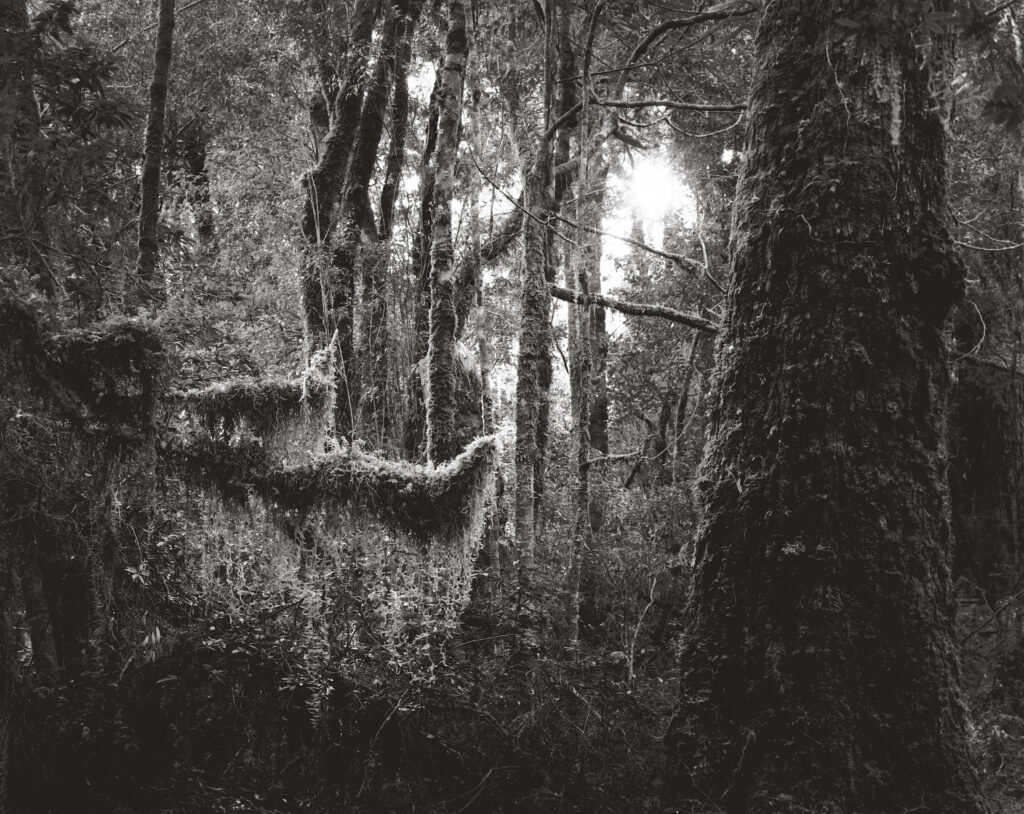
Visual hotspots are difficult to avoid when shooting into the rainforest canopy, but in this case I was hoping to make a positive use of the phenomenon. Allowing the sun to infiltrate a relatively small area of the canopy, and choosing a viewpoint that helped eliminate highlights from the print edges has, I think, allowed the entity to co-exist with this reclusive forest in a supportive way.
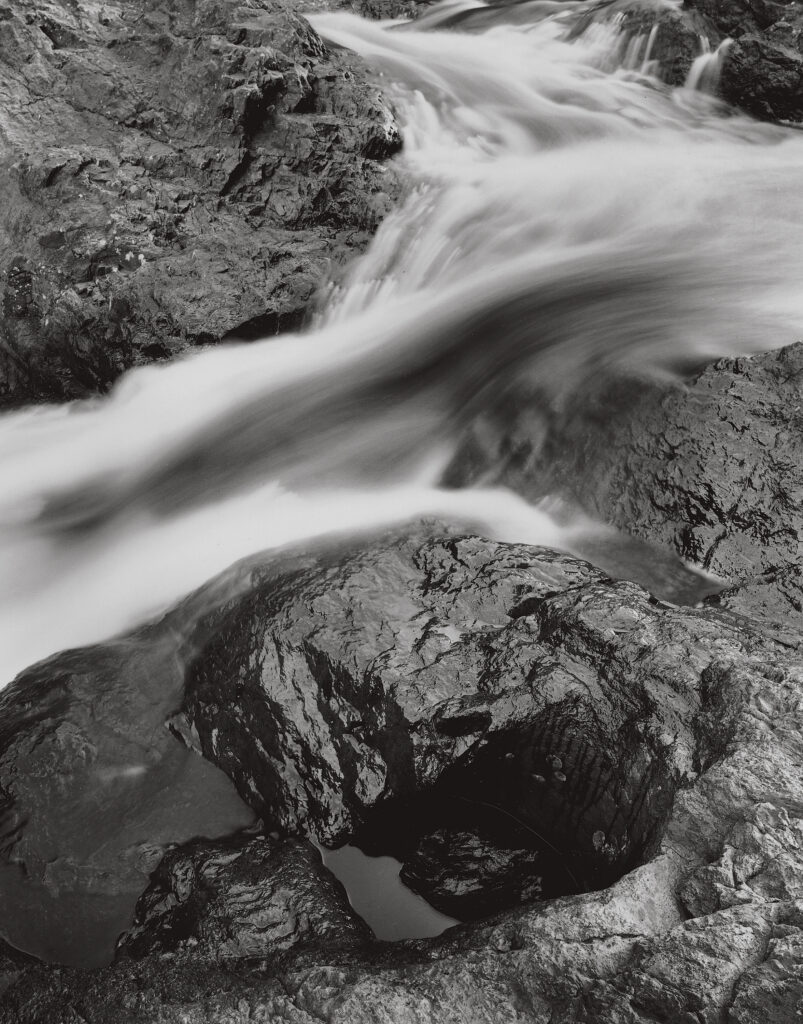
The waters of the Stitt River find their way into the Pieman, with the latter marking the southern boundary of the Tarkine. This photograph was made on the 4×5 near Rosebery, where the Stitt skips from side to side over a series of obstacles. I was rather taken by the textural water flow and glistening rocks, together with an innocuous river-bed pot hole that to me speaks of a much more boisterous river presence.
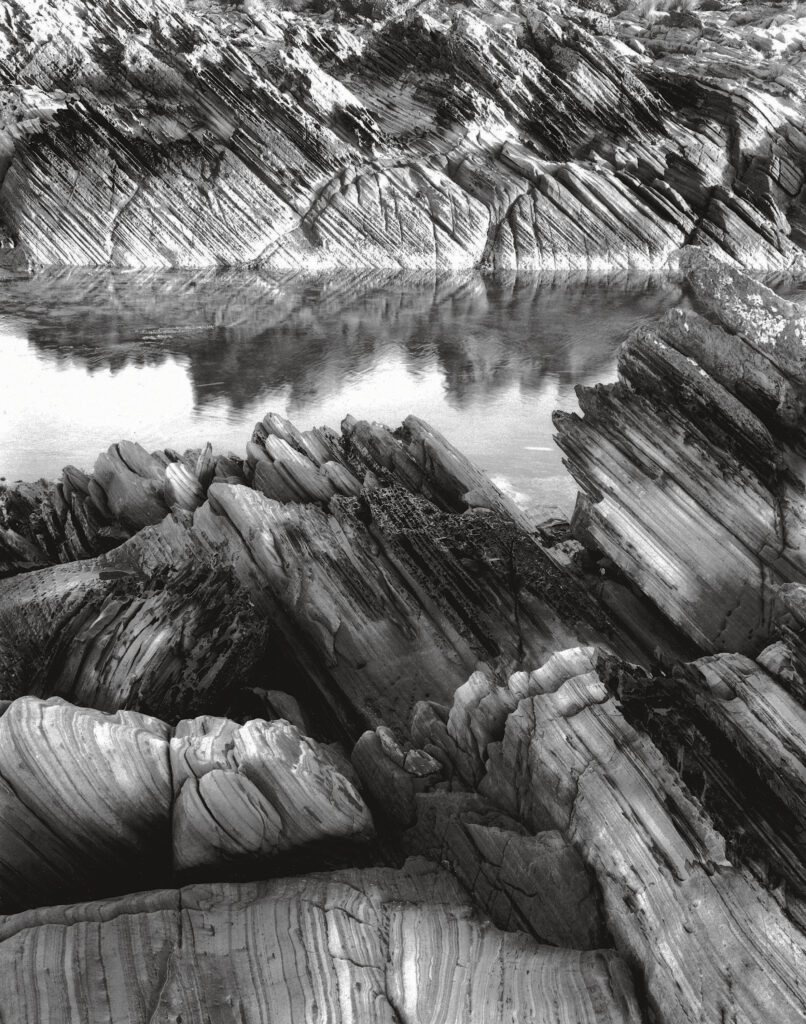
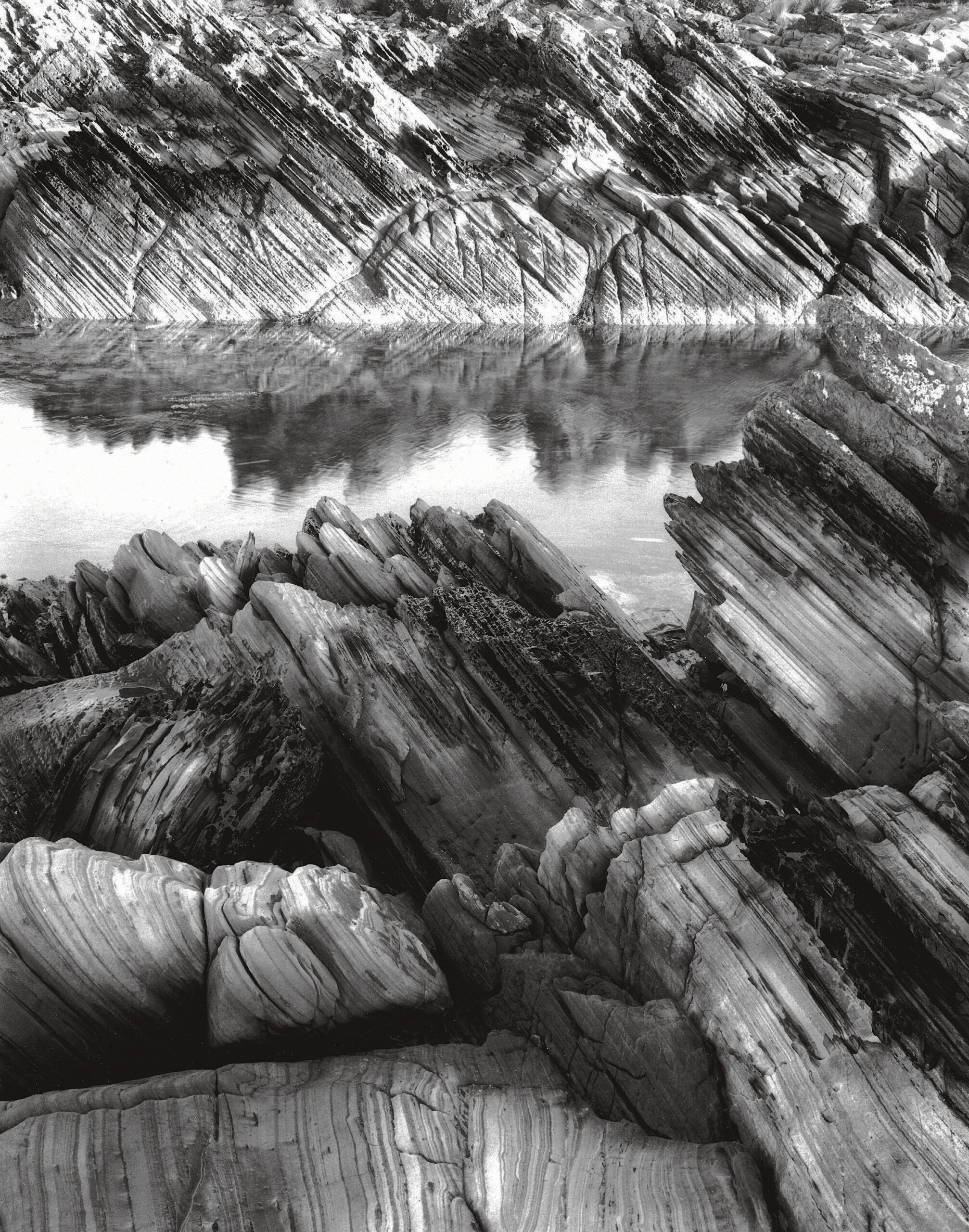
The angular rock strata near Sundown Point is replicated elsewhere along the Tarkine Coast, but I gravitated to this scene partly because of its inverted reflection and partly because of the dramatic architecture. A short telephoto lens on my roll-film view camera helped drag the background into the foreground rocks, and allowed me to select a piece of coastline with homogeneous textural qualities. Once focused, I waited for the sea water to stabilise between waves, before exposing the film.
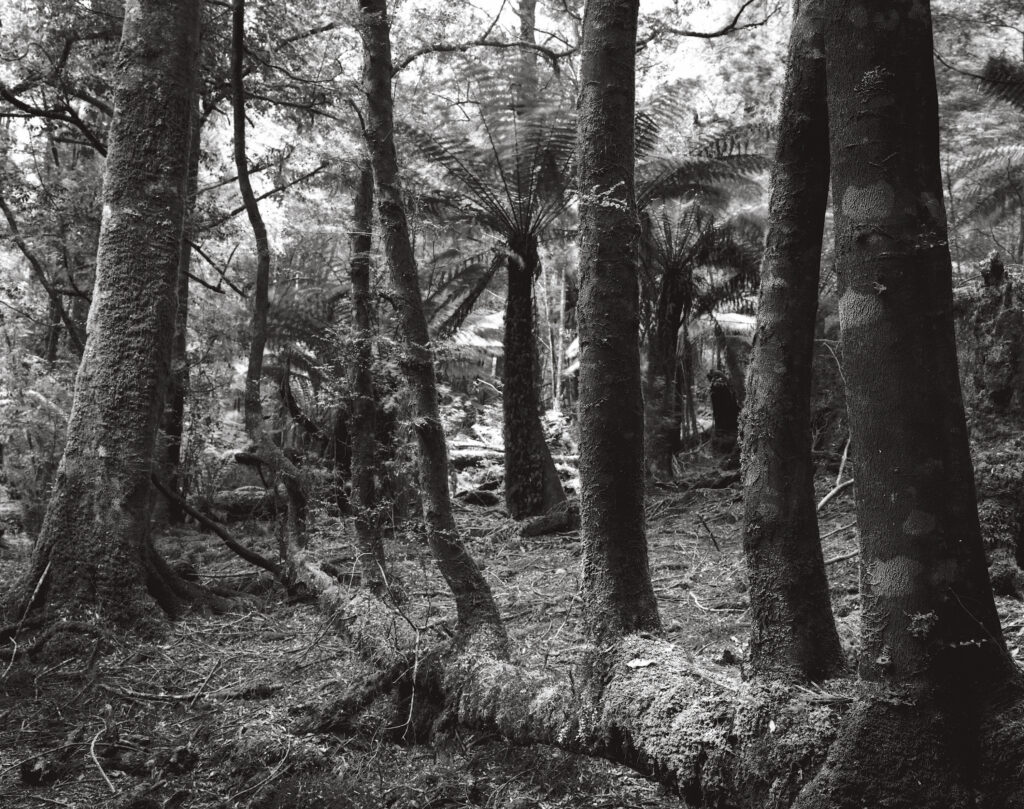
Many rainforest scenes in the Tarkine are so complex, so busy in a structural sense, that I found it difficult to settle on a particular composition without potentially needing to accept some level of visual compromise. This particular image was taken near a location I have previously visited (and photographed), and while I prefer my original print for its symmetry and light play, I was also happy to explore other options. Like many rainforest captures, this setting required a long exposure, and at the time of capture, a willingness to accept some subject movement.
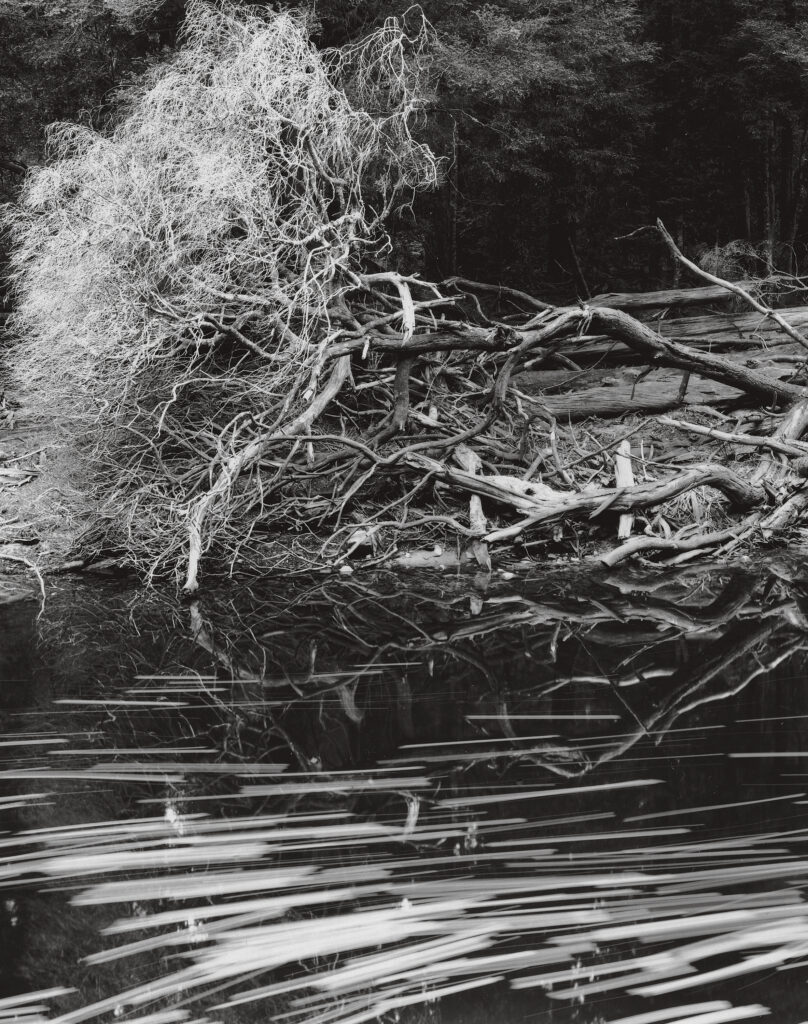
Periodic flooding on the Rapid River has pushed vast quantities of organic material into tangled piles of debris. Leeching tannins have coloured the waters with a tea-like tone, liberating mobile clusters of foam from every bubbling turn in the waters. I set up my 4×5 to capture this action from one of the few vantage points accessible along a rather congested piece of waterway.
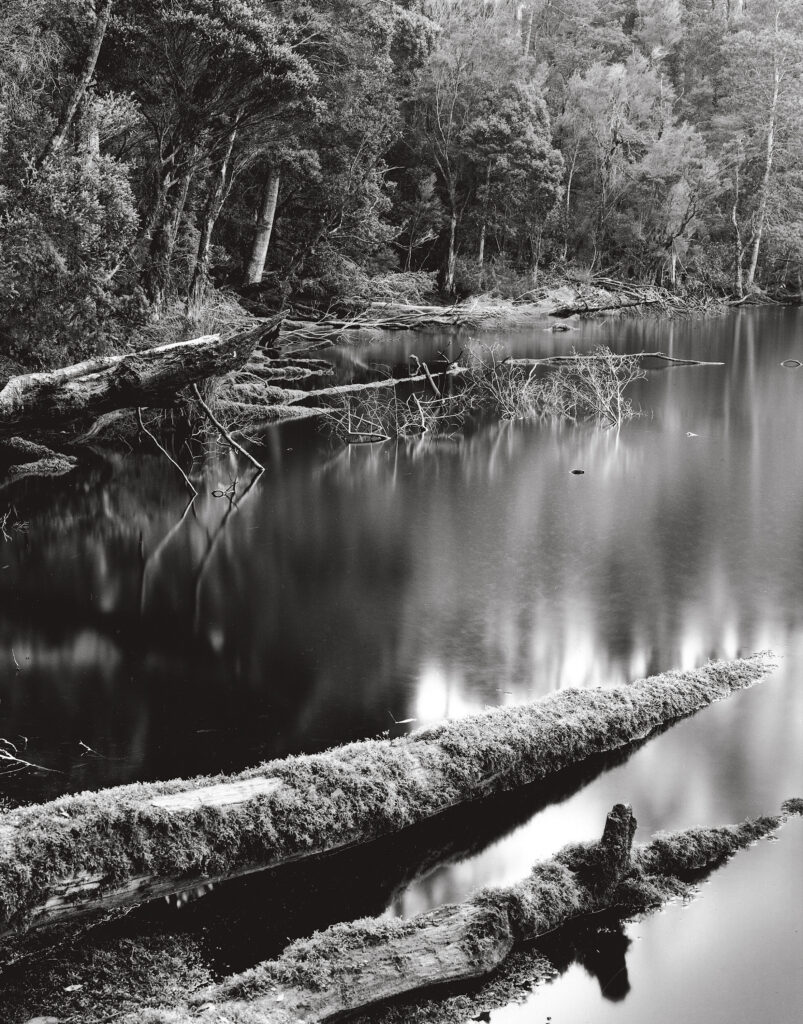
Very light drizzle had softened the water at Lake Chisholm when I arrived early one morning. The walk in through dimly-lit rainforest was a delight, but little prepared me for a vision that appeared to have disregarded time over countless generations. I kept the 4×5 relatively low for this capture in an effort to pull the reflected highlights onto the foreground tree, then applied enough tilt to maintain focus throughout.



A beautiful set of images accompanied by a great insight into the process of making this set. Thank you for publishing this work, very inspirational….
Thankyou very much Charles, I also like to hear how and why other analogue photographers approach their subjects.
Wonderful write up of a relative unspoiled area. That “Tilted” image is beautiful in its tones are texture.
I can only echo Shane’s comment: “Tilted” is a magical image.
Thankyou Shane and Peter, there are some fantastic subjects along the Tarkine coast, and with so few visitors and sympathetic lighting it is a wonderful place to bring the view camera.