The Great Sandy – Murray White
As the world’s largest sand island, K’gari – Fraser Island, is blessed with a remarkably diverse landscape and attracts many visitors. More than 400,000 pilgrims visit the destination annually, yet anecdotally I would claim that the majority of these people travel here primarily to fish or camp, or as part of a spirited backpacking holiday. Some individuals may venture over for whale spotting, bird watching, or even for academic purposes, but the number that arrive with a view camera would be very few indeed.
This is a great pity as the island should not be seen as simply a convenient platform from which to cast a line, or to just exist as a sandy refuge for dingoes. K’gari has a much more complex topography than many would appreciate, and the opportunities for photographic exploration are considerably deeper than what may be expected. Admittedly the challenges of view camera usage on a sand island are many, but isn’t that also the case in most other wilderness areas?
I recently spent a week here, and while our small group undertook the more typical activities found on this holiday destination as well, I had a number of opportunities to get under the dark cloth. We toured a large part of the island and camped at a new destination every night. My habit of choice was to undertake an early morning and sometimes late afternoon camera walk wherever we happened to be, and let fate dictate the subjects and lighting conditions.
Vehicle based camping is largely biased to east coast destinations, from where prescribed and informal walks can be undertaken. There are some magnificent walks across the island, with dense woodlands and both perched and window lakes contributing to the variety of terrain that can be enjoyed. Central Station in the island’s interior has superb camping close to the few remaining groves of old-growth forest that escaped the pioneering timber cutters but was closed for an upgrade at the time of our visit.
We were also impacted by an unusual winter rain event for most of our time on the island, which required some agility in regard to camera equipment selection. During periods of persistent rain I chose to use my compact (and easily deployed) Mamiya 7, while the more typical, largely mobile cloud cover periods, were ideal for my 2×3 Ebony view camera. The 4×5 was used during the day when the weather was generally more stable.
There were a number of practical considerations to deal with on the island too. Perhaps the most frustrating reality was having to work around the constant stream of traffic plying the east coast beach. Not only did this make the actual photography difficult, but remnant tyre prints in the sand always seemed to be in the way visually. I found early morning to be the best time for beach photography, especially on a receding tide, when vehicle travel was at a minimum.
Dealing with wind-blown sand was a regular challenge too and my practice was to keep the camera always in a backpack until I was convinced of a composition with the tripod already deployed. I used a small plastic sheet to rest the backpack on and minimised the pack’s time open by keeping a light meter and roll film back sealed in the pockets of my jacket. Thorough cleaning of photographic equipment was a regular activity in camp of an evening.
The resident dingo population has received negative press in recent times, and unfortunately it is not without some truth. On previous visits to the island I have had no issues, but on this latest visit I had an encounter that was a little disturbing. It appears that long term inappropriate interaction between humans and the animals has had such an impact on their behaviour that it now demands a more proactive outlook by visitors. Plenty of National Park signage warns of potential dangers, and ways to mitigate the risk. It is advice well worth following.
There are many options for travel onto K’gari, and the most efficient way would depend on your circumstances. Self drive by full size 4WD is perhaps the more practical choice if you have a large amount of gear or wish to personalise the itinerary. You can take your own vehicle over by barge, or hire a vehicle locally (on the mainland), but some sand driving experience is essential, especially if you intend to drive the inland tracks or venture north of Orchid Beach. Tour buses are another option and various accommodation possibilities are available at the few small villages on the island.
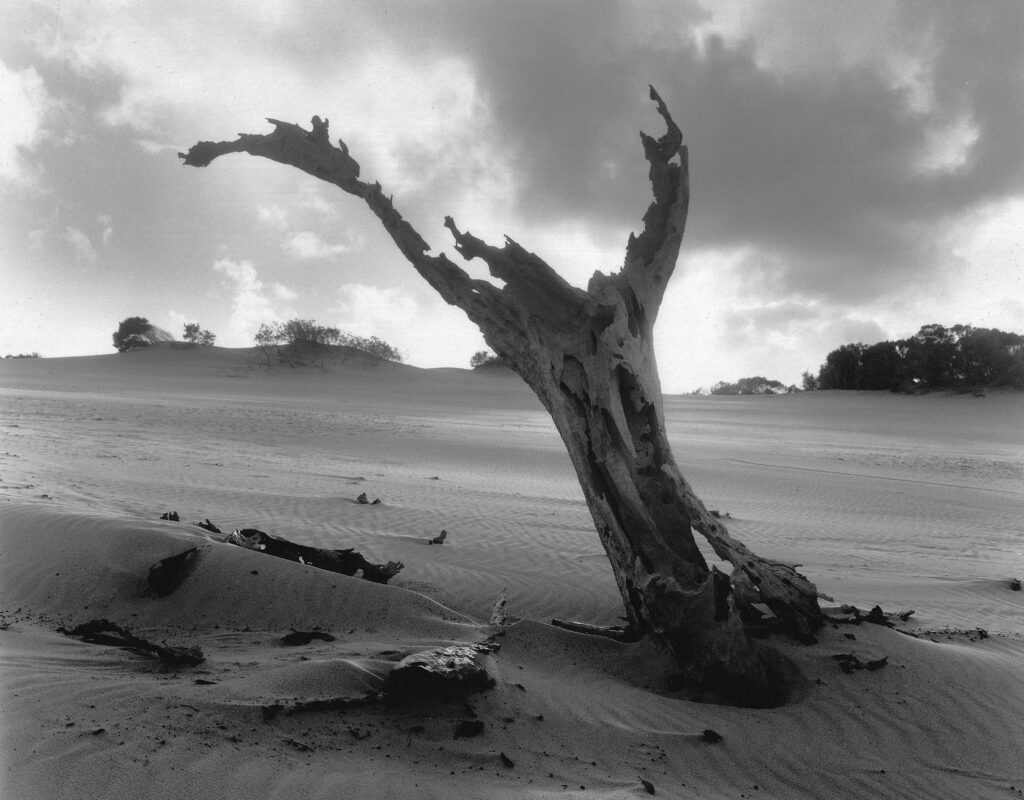
K’gari is home to numerous sand-blows, where wind erosion and unrelenting waves of sand have swallowed vast tracts of vegetation. This particular site was littered with broken trees, some determined bushes and grasses, and the most exquisite of sand sculptures. This subject seemed at once stoic and resilient, yet apparently fragmenting before my eyes. The background cloud was a useful feature in my opinion, although my desire for it to partially obscure the sun never eventuated, and a lower or closer viewpoint proved impractical at the time.
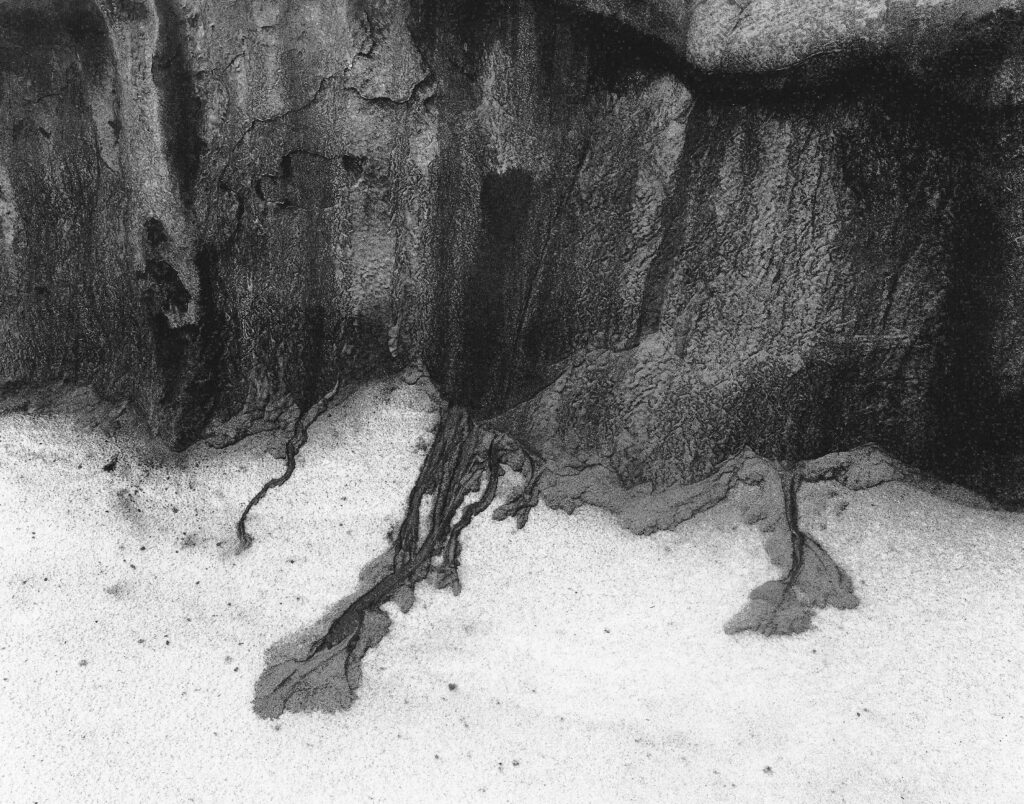
While most of K’gari’s coastline sand gleams almost pure white with occasional ochre colouring, the black sandstone of Ngkala Rocks offers a striking alternative. Eroded fingers of this graphic feature reach into the ocean like a bitumen jetty of indeterminable age. I spent some time walking around the southern outcrop, but found more intrigue in the minor details, like these bleeding lines of tar coloured sand. As with many other features on the beach, a clean sweep of high tide washes away the fragments of coastal life, to leave an apparently blank and untouched canvas on which to frame the raw elements as the cycle continues.
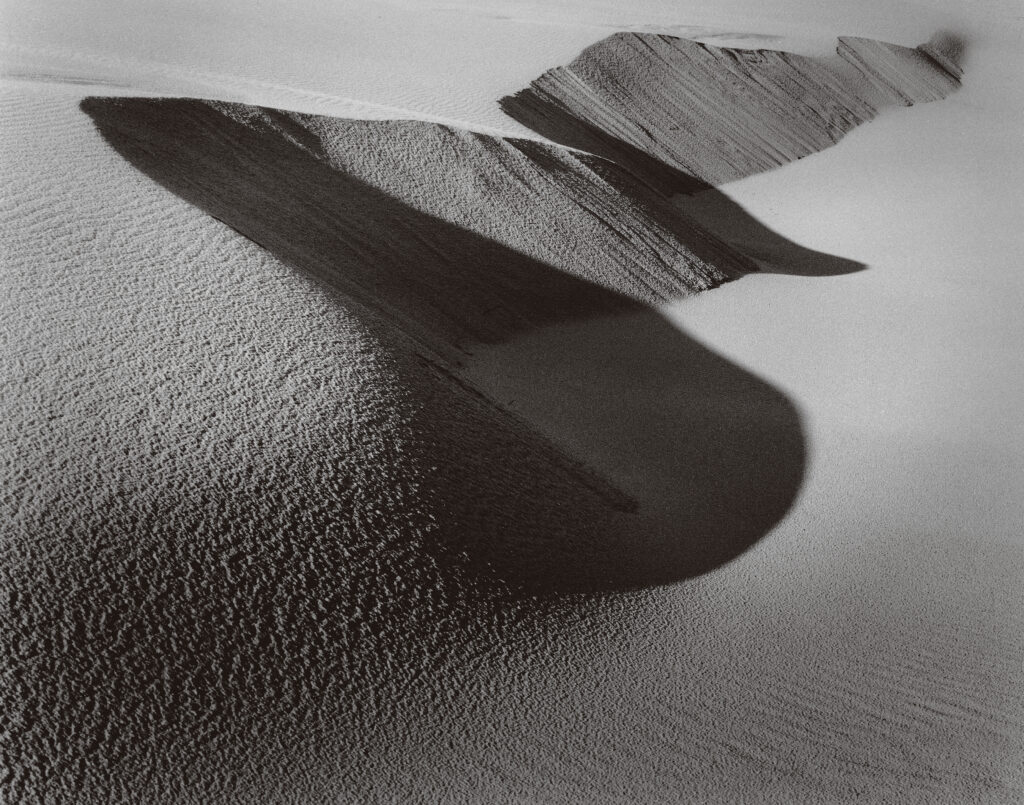
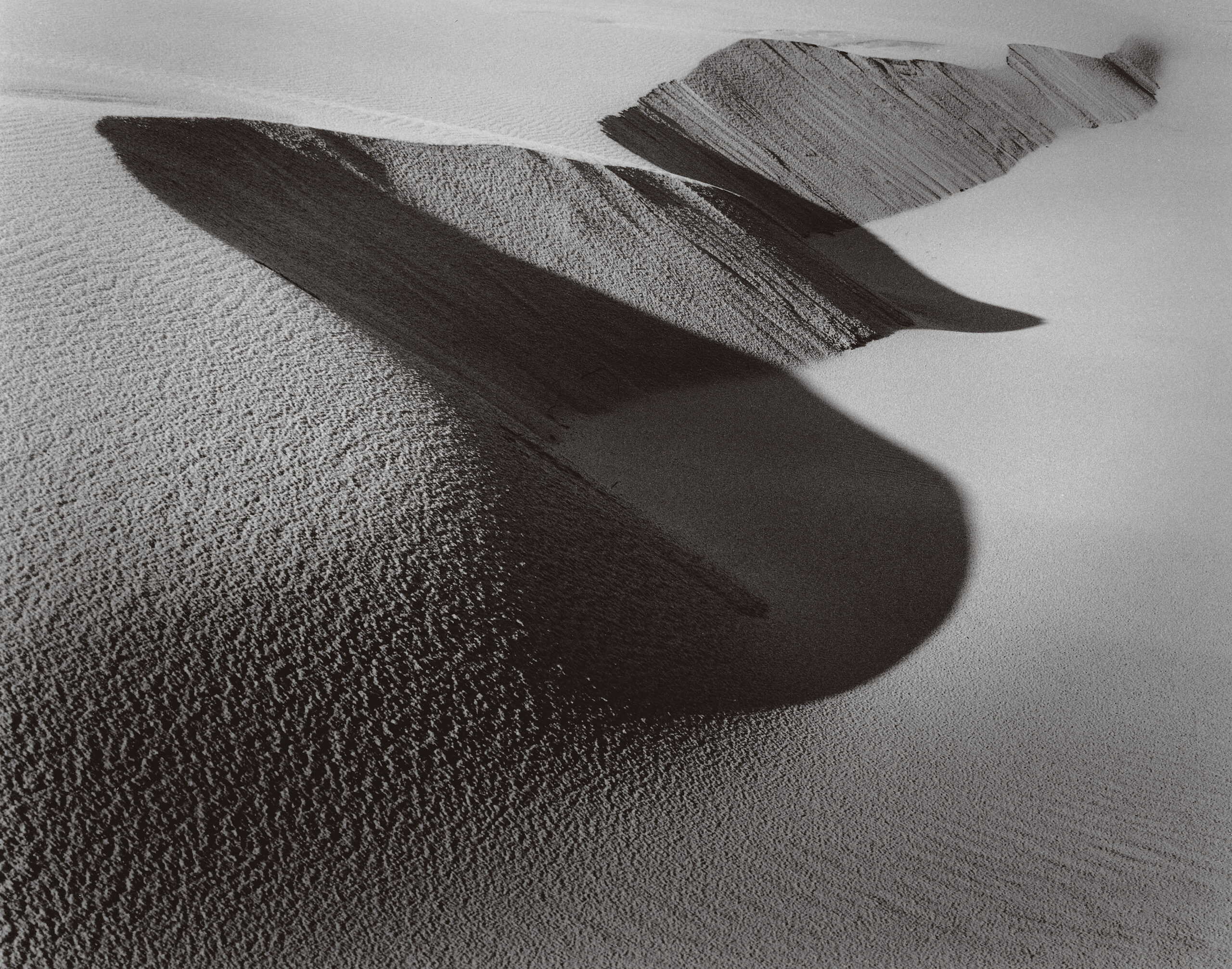
I found the early morning light to be most effective when looking for potential in sand hill areas. While I often prefer pre-dawn light for some subjects, the low contrast reality of the dune and swale system at this time of the day does not always validate the topography. On the other hand, more direct lighting around midday can override the tonal graduation that I feel can contribute to a pleasing sense of visual ‘fluidity’. For this composition I used a short tele-lens on my 2×3 view camera and waited for the thinnest of clouds to slightly diffuse the sun’s rays.
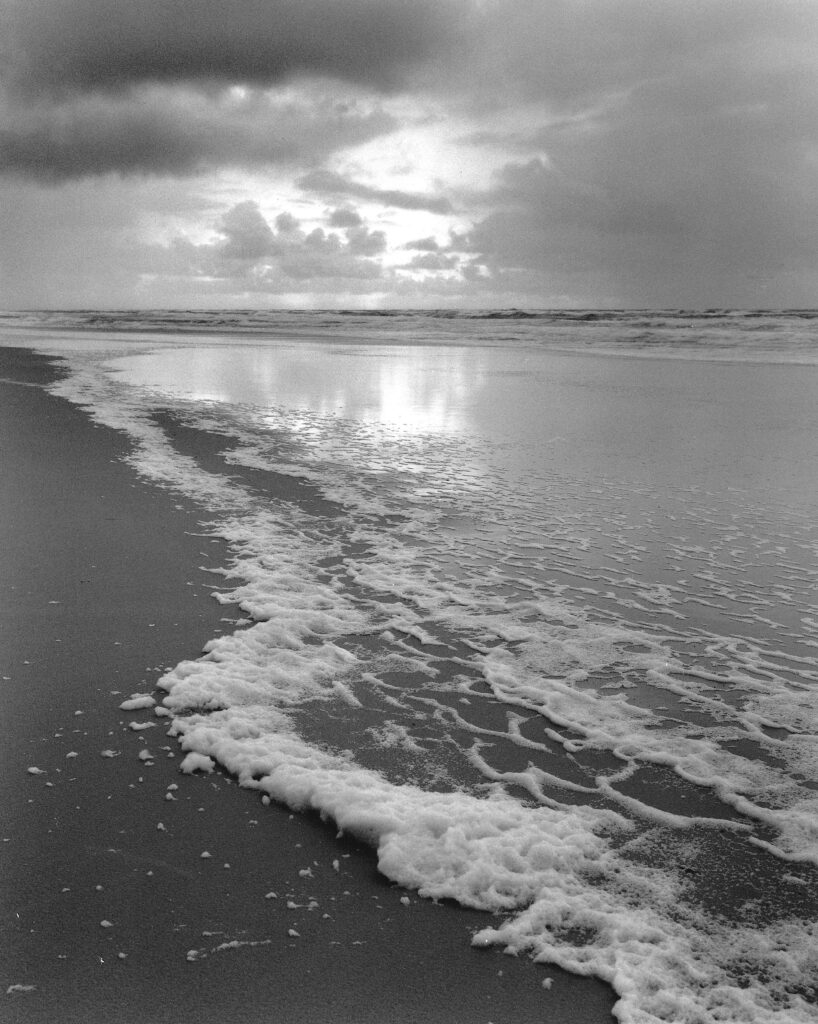
An unseasonal dose of winter rain and wind had stirred the ocean into a foamy mass on this day, and on an outgoing tide the remnants of this fury were as static as I could hope for. With a slightly wide-angle lens on my Mamiya 7, I could plant my tripod into a suitable site with focus and exposure settings already made, before framing the composition. I would leave the lens cap in place until just prior to tripping the shutter in an effort to limit salt spray and water droplets on the glass. Being able to frame the subject while keeping the front element covered is a huge advantage with a range-finder camera in these circumstances.
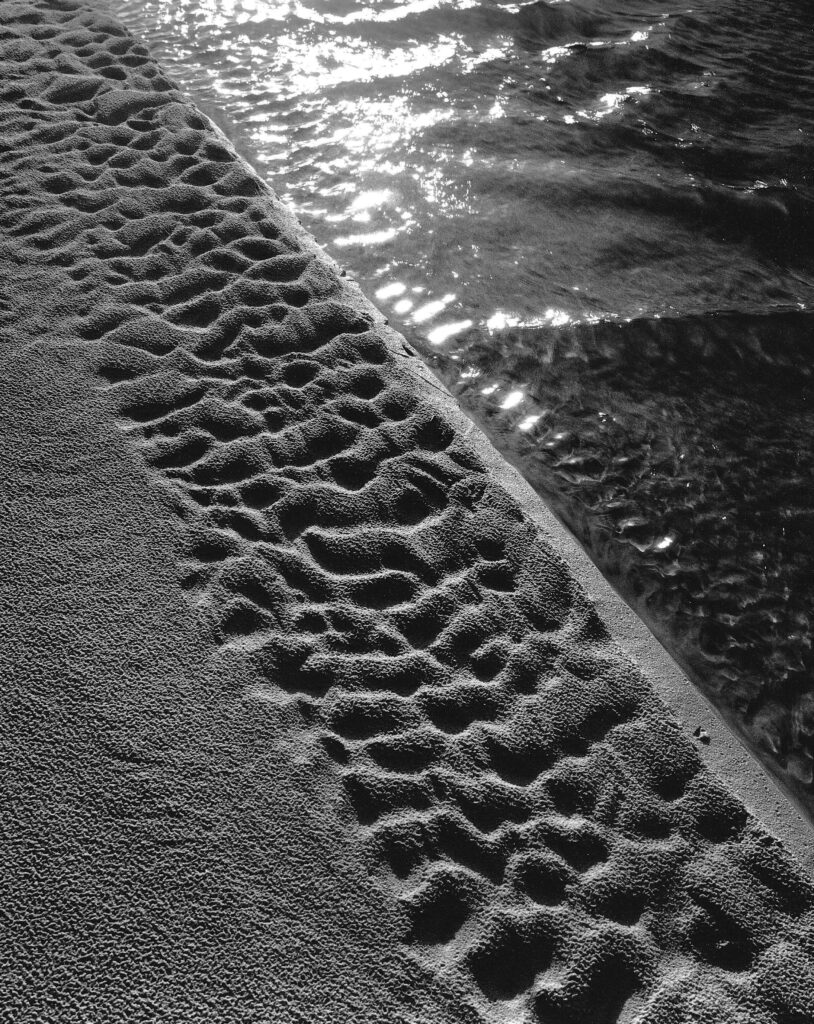
The potential for photographic studies of texture on the beaches of K’gari are virtually unlimited. The sand ripples and drainage patterns bear witness each passing day to a new set of wind and tidal variations. I often gravitate to diagonal compositions, especially where a dominant line separates two different entities. I think the forced juxtaposition encourages a comparison to be made – in some cases to identify the differences, and in others to search for the similarities (or perhaps both!).
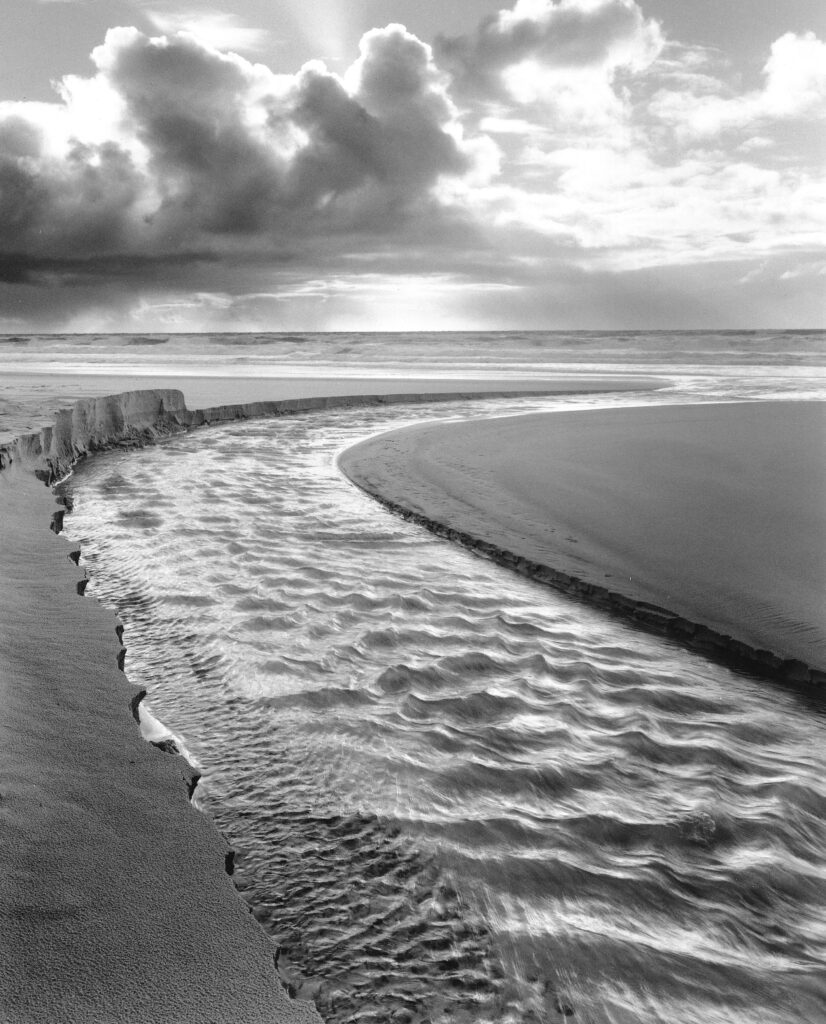
There is a staggering amount of freshwater that drains from K’gari’s sandy interior back into the ocean. Dozens of creeks and rivulets merge with the saltwater at geographically variable estuaries. Highly mobile sand banks are pushed around by wind and tidal activity, giving each spill over point an individual character. I made this photograph on the 2×3 view camera hoping to capture some of the drama with rippled water and evolving cloud action.
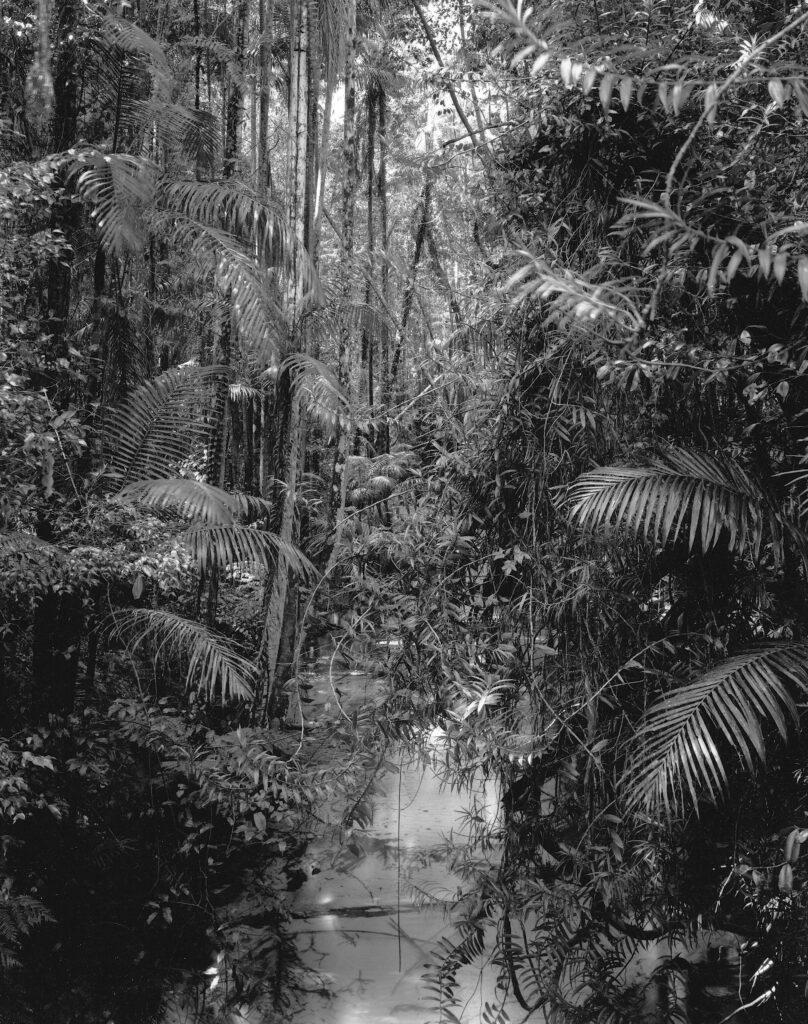
The impossibly clear waters of Wanggoolba Creek flow through rain forest so visually impenetrable that the creek itself is the only form of separation. Nearby Central Station camp was closed to campers when I set up the 4×5 here, so as the day of our visit had coincided with a gentle breeze, I had no option but to accept a little bit of minor foliage movement. In the dimly lit jungle I recall an exposure time of around 30 seconds at probably f22, but I have to confess, that away from the fixed reality of using the cable release, the atmosphere within this forest is as timeless as you can find.
K’gari is a World Heritage Site.


Exceptional work as always Murray, distinctive photographs and an interesting write up!