

The Gate at Pentridge. Silver gelatin print. Walking through former Pentridge…
Harry Nankin’s Acts of Ritual, 2020-24
I live near the bottom of a shallow squiggle of the Great Dividing Range, in the watershed of a fast little branch of the Loddon, which is a big tributary of the much bigger, muddy, winding, Murray. It’s a broad, elevated, water-corrugated sandstone basin punctuated by volcanic cones and granite rises, one of which, Mount Alexander (or Leanganook in the language of its original Indigenous owners, the Dja Dja Wurrung clans), is the district’s administrative namesake. Once, not that long ago really, much of the region was inhabited by sclerophyll forests canopied by widely-spaced, broad-girthed, old red gums, yellow gum, grey box, long-leaf box and red ironbarks and floored by an exceptionally biodiverse understory of herbs, bushes, grasses and orchids. In the 1830’s white squatters began to steal the flats and valleys from the Dja Dja Wurrung for livestock grazing. For the Aborigines, it was a calamity. Decimated by European diseases and deprived of sustenance, their resistance was met with mortal reprisal. Several documented massacres at known locations by armed settlers between 1838 and 1846 are the tip of a bloody iceberg the true scale of which will probably never be known. Then, in the middle of the century, tens of thousands of ravenous fossickers, many of them hardened panners from the California rush, severed the trees and disembowled what lay beneath, turning the auriferous earth ‘upside down’ trampling, burning, sluicing and spading for gold. The post rush-scape of bare ground, erosion gouged gullies, pock-holed hillsides, quartz-flecked muck heaps, spidery water races, earthen dams, rusty pipelines and crumbling pump houses nowadays appeals to frontier partisans and tourist sentiment. The residue of that ransacking has been enveloped by a slowly regenerating over-story of thin, multi-stemmed coppiced trees with sparse, often weedy, undergrowth, quite unlike the mature forests stably stewarded for tens of thousands of years by its First Peoples. Revived mining, residential subdivision, expanding infrastructure, an absence of traditional Indigenous fire-stick practices, dieback from cinnamon fungus, cup moth caterpillar infestation and, above all, climate change, threaten further recovery.
I do not find this unprepossessing, trampled country easy to be enthralled by, let alone, love. It’s not that I’m oblivious to its beauty. The big, open skies. Transparent blue, dry, for weeks, in the hot months. Fogs, frost, rain, churning, streaming cloud, in the cool. A hundred kilometres from the sea and a third up, when the sun sets, the temperature plummets. Nights, so dark and sparkling, you can often make out the dark emu. Although natural variability exacerbated by global heating renders any climate forecasting uncertain, for the time being at least it remains true that in winter, the namesake flowering of golden wattle, Australia’s floral emblem, brocades these forests. And, in spring, blue bunonia, purple chocolate lilies,yellow billy buttons, yam daisies (or murnong, once an Indigenous staple), and white, pink and red common heath (Epacris), pigment the understory. Without a map or GPS, you can rough your whereabouts triangulating by eye the familiar, comforting, blue, wooded prominences of Leanganook and Tarangower, the volcanic crater of Langambrook (Mount Franklin), rumpled Fryers Ridge, and, if you have far views, the granite-torred ‘mountain of light’ Guyura (Mount Kooyoora), fabled, crenelated Ngannelong (Hanging Rock) and the sylvan, kilometre-high saddleback of Geboor (Mount Macedon).
Many of those who already do or wish to love this region are working assiduously to conserve and reprise the landscape and its ecology, with some success. Of course, nobody can bring back the carpet of mature forests or the legion of extinct species or completely disappear the weeds and feral cats, foxes and bunnies or right the quarried upside-down soil profile. It’s protecting and understanding what remains that matters: the surviving grand old trees, the recuperating woodlands and their complement of rare, threatened and endangered creatures whose multi-consonant settler common names, listed spoken, tangle the tongue. Eltham copper butterfly. Brush-tailed phascogale. Fat-tailed dunnart. Woodland blind snake. Eastern bearded dragon. Many-lined delma. Lace monitor. Growling grass frog. Brown toadlet. Southern bell frog. Powerful owl. Barking owl. Black-chinned honeyeater. Brown treecreeper. Swift parrot. Diamond firetail.
I am not alone in wishing the region’s bushland, creek lines, hilltops and ridges could be returned to something like they were under indigenous care, before the squatters and the gold rushes. But achieving that might be as counterproductive as it is improbable. Yellow-tailed black cockatoos are an infrequent delight as they call overhead, feed on the seeds of planted and invasive monterey pines instead of the banksias and other natives removed to make way for plantations of the American tree, as well as mines, farms and towns. Regrowing banksias on disturbed ground is problematic and the yellow tails would almost certainly perish without the pines. There is a scattering of miners and farmers dams across this landscape. One of the biggest, earth barraged Expedition Pass reservoir constructed during the gold rushes diverted and drowned once-wooded Forest Creek valley. Artificial it may be but, in an increasingly irritable climate, this impoundment, like others, offers reliable habitat for sedges, rushes and reeds, reed warblers, welcome swallows, frogs, dragonflies, ducks and a treasured, safe, swimming hole for locals, who affectionately dub it, The Res.
Road and railway cuttings dissect this hilly country. Some are spectacles. Along the boundary of the Castlemaine Diggings Heritage Park near where I live there’s a hundred-metre-long, three-metre-high corridor of vehicular cut-through. Walking it, you passage through a Neapolitan mineral extravaganza millions of years long. Plump band upon thin layer upon tendril stripe of sandstone, slate and mudstone in differing, alternating hues of blue-grey, deep purple, olive, grey-white, yellow and jet-black, spotted with blobs of tan, the bulk tilted 70 degrees from the horizontal, intercepted here and there, with perpendicular fractures and shelves. The laminations are Lower Ordovician sediments, laid down 487 to 475 million years ago into a shallow Gondwanan seacoast eroded from a vast mountain range to the west. The sediments were hardened to stone by time, heat and pressure before arising, folded and twisted oblique by colliding continents. The early Ordovician was an era of greenhouse swelter, molluscs, cephalopods and graptolites, way predating dinosaurs, trees or Australia. Scout the excavated tops, and look down to the ground, you notice the parallel rills of eroded lamination, like most of the local geological faults, align precisely north-south. A stratigraphic compass. Here, to speed machine locomotion, primeval oceans and deep time have, unwittingly, been scraped into view, haunting the seams we step on and the veins we touch.
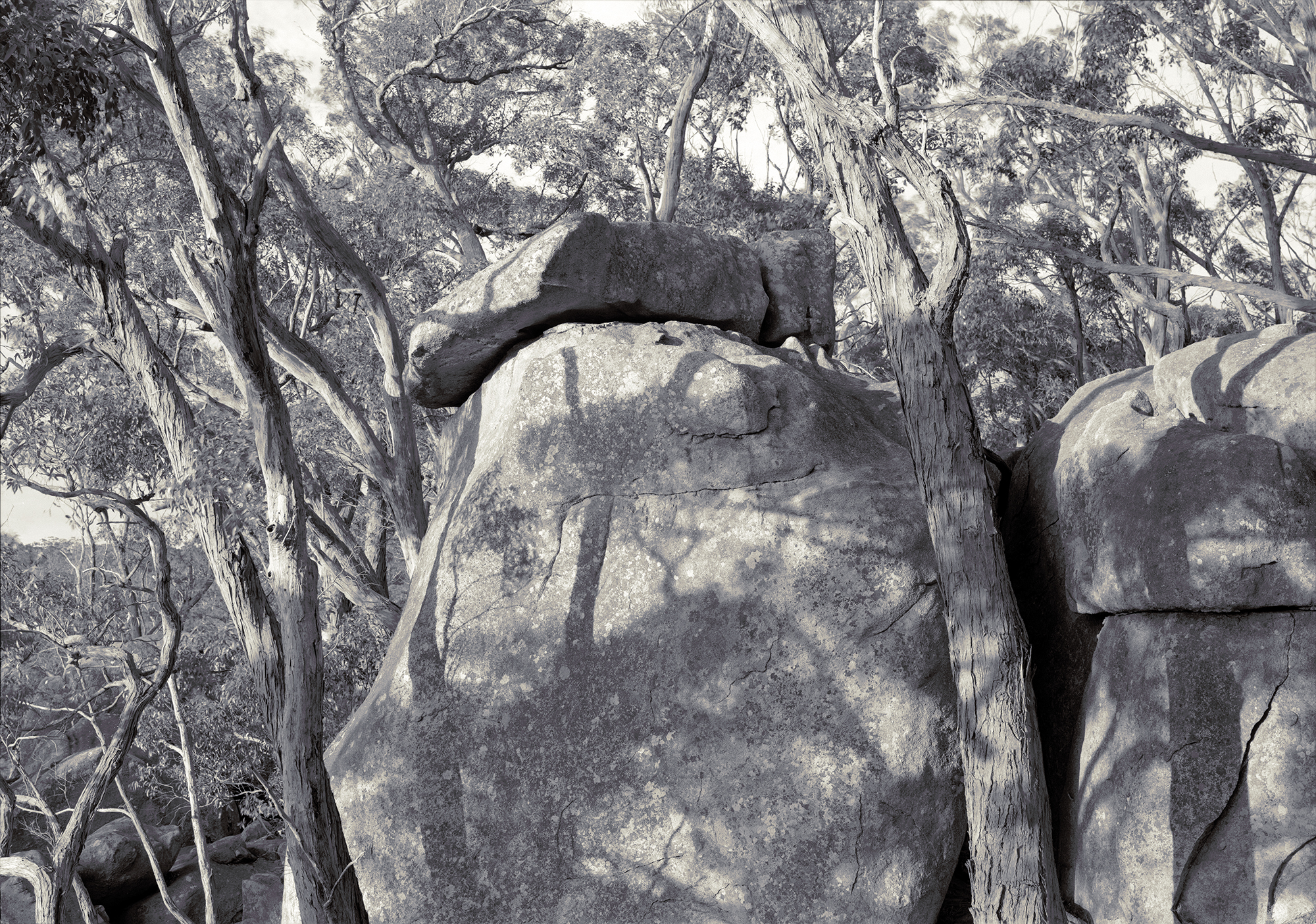
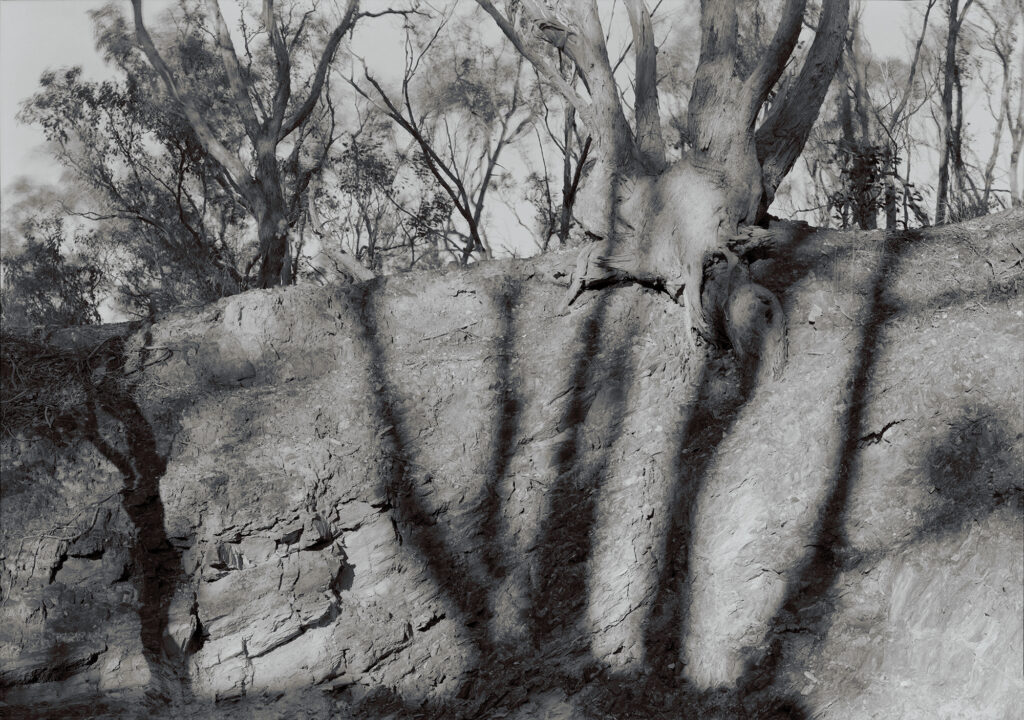
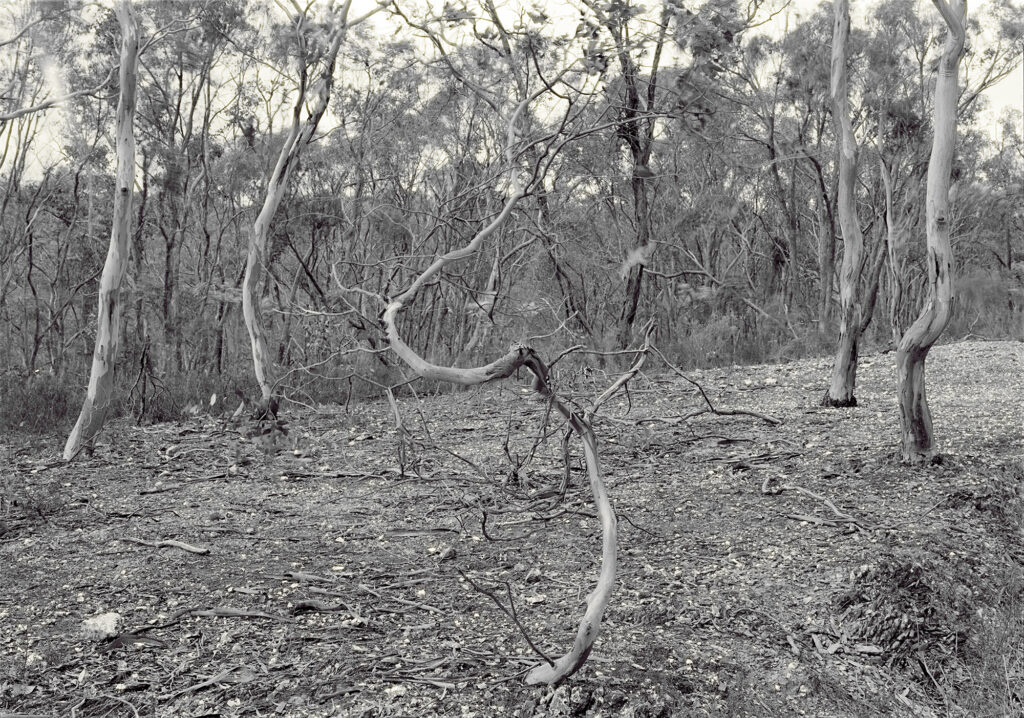
I returned to the craft of slow lens photography in 2020 using a pre-loved ‘5×7 inch’ Deardorff wooden field camera, during the pandemic, primarily to try to learn to love this country. I endeavoured to approach each photographic act as if it was a ritual, devoted to glimpsing the light of presence imminent within, behind and beyond the shadows. The archaic optical and photochemical technologies I employ are analogous to those in use before Djandak’s trees were felled, its rind was mutilated and its custodians banished, but of which no photographs are known to exist. They report a wounded landscape in which distinguishing what is natural from what is not is confounded. My images of Leanganook are already memorial: in January 2026, a bushfire wiped away most of its regrown one-and-a-half-century-old forest. In being granted these pictures, my recurring question was (and remains still) if and how I (or anyone) can experience this country as precious, beautiful or indeed, sacred, without ignoring, ennobling or wishing-away its injuries, incursions and absences.
Post-processed scan of a 5 x 7 (12.7 x 17.7 cm) gelatin silver negative.
Post-processed scan of a 5 x 7 (12.7 x 17.7 cm) gelatin silver negative.
Post-processed scan of a 5 x 7 (12.7 x 17.7 cm) gelatin silver negative.
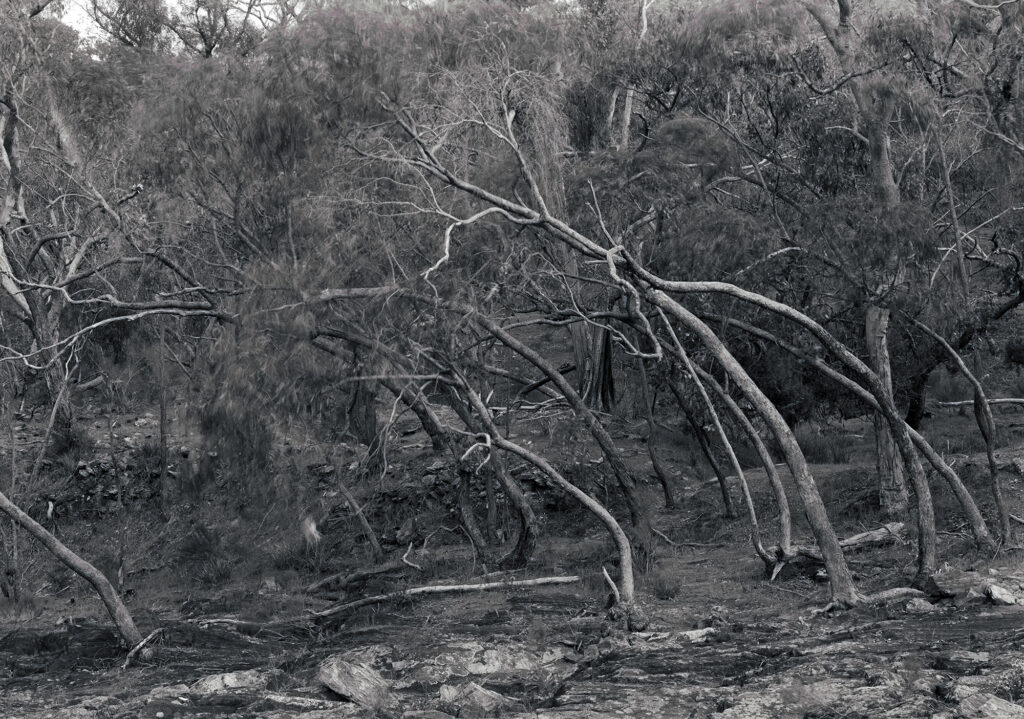
Post-processed scan of a 5 x 7 (12.7 x 17.7 cm) gelatin silver negative.
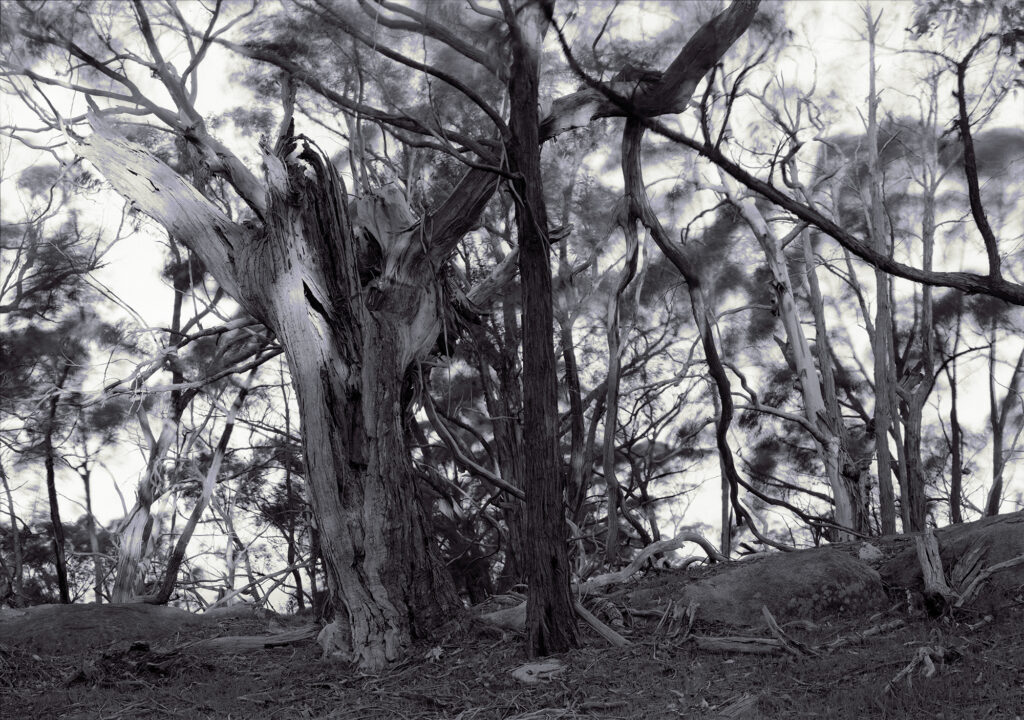
Post-processed scan of a 5 x 7 (12.7 x 17.7 cm) gelatin silver negative.
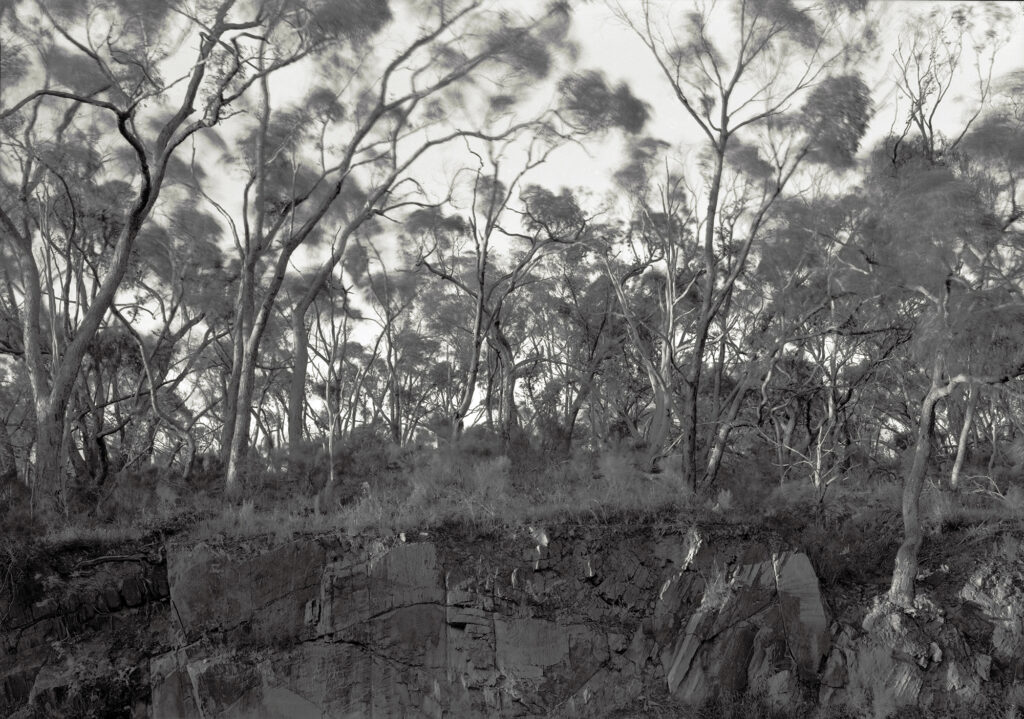
Post-processed scan of a 5 x 7 (12.7 x 17.7 cm) gelatin silver negative.
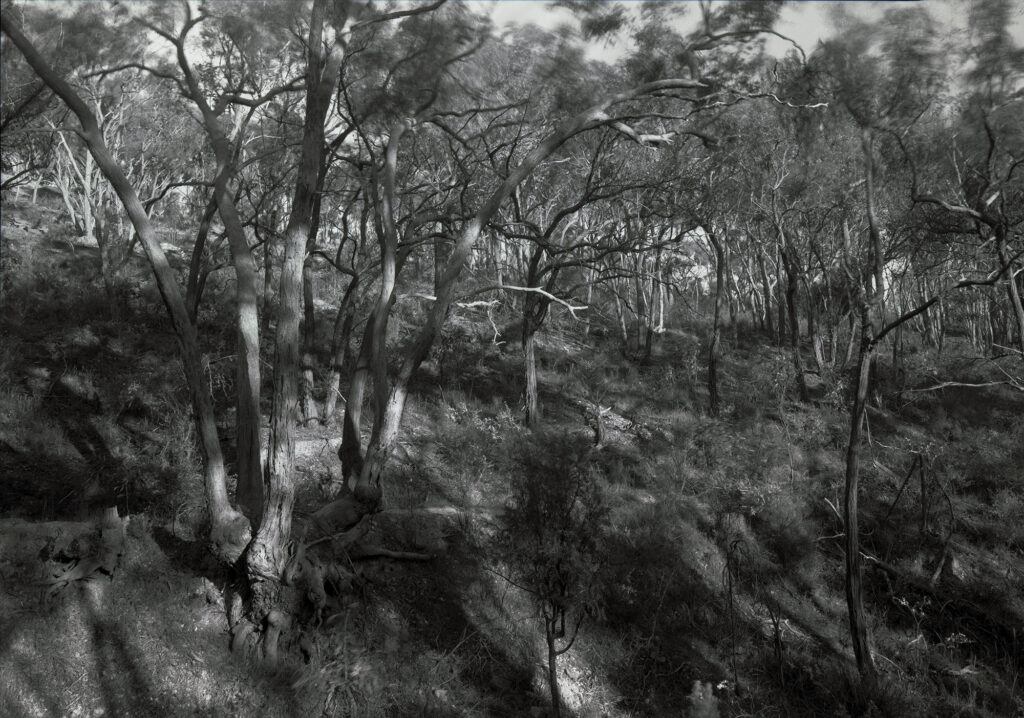
Post-processed scan of a 5 x 7 (12.7 x 17.7 cm) gelatin silver negative.
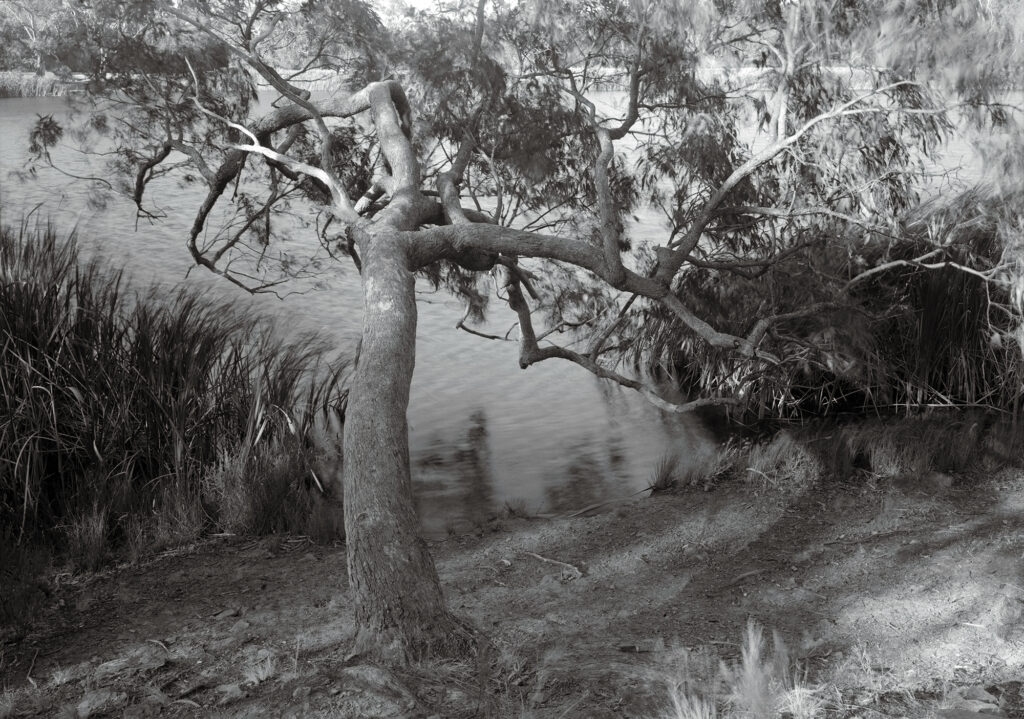
Post-processed scan of a 5 x 7 (12.7 x 17.7 cm) gelatin silver negative.
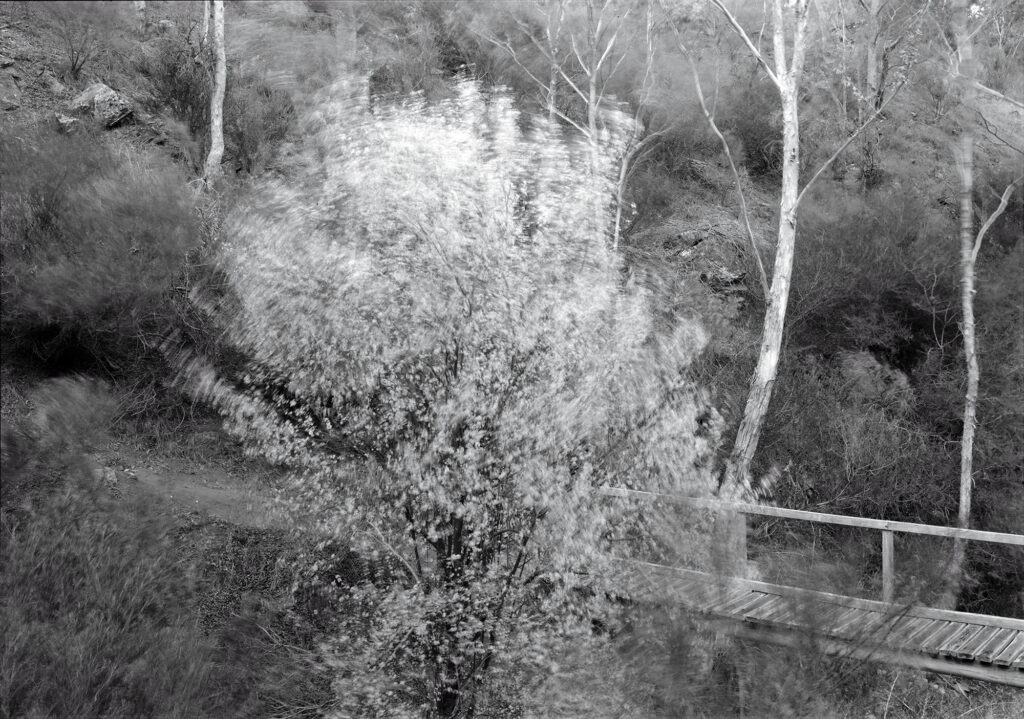
Post-processed scan of a 5 x 7 (12.7 x 17.7 cm) gelatin silver negative.
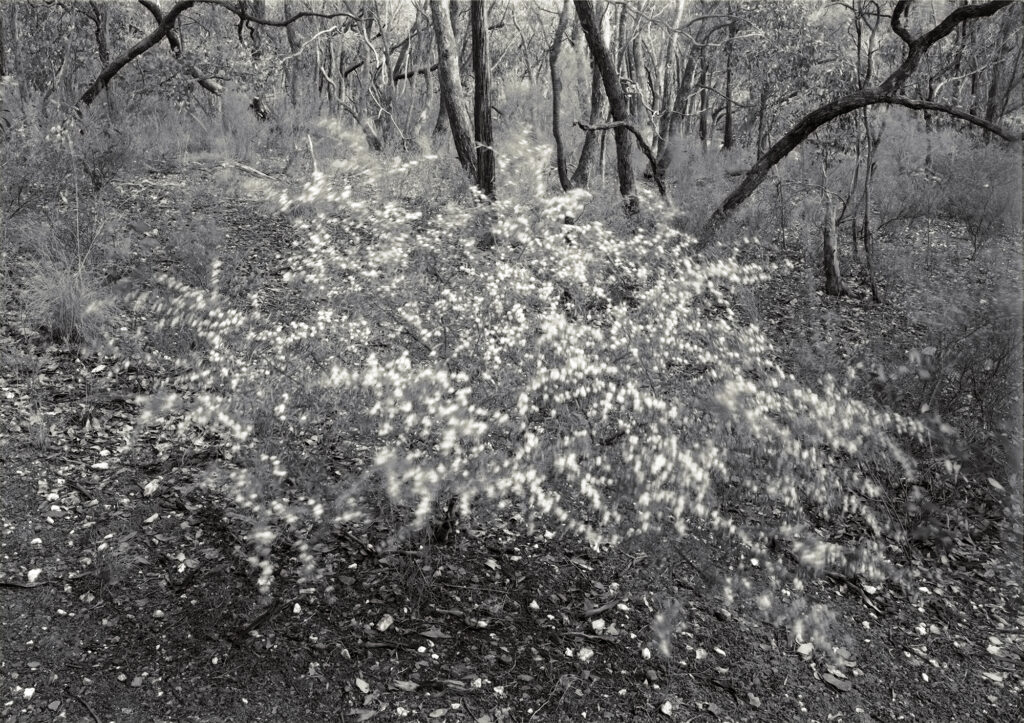
Post-processed scan of a 5 x 7 (12.7 x 17.7 cm) gelatin silver negative.
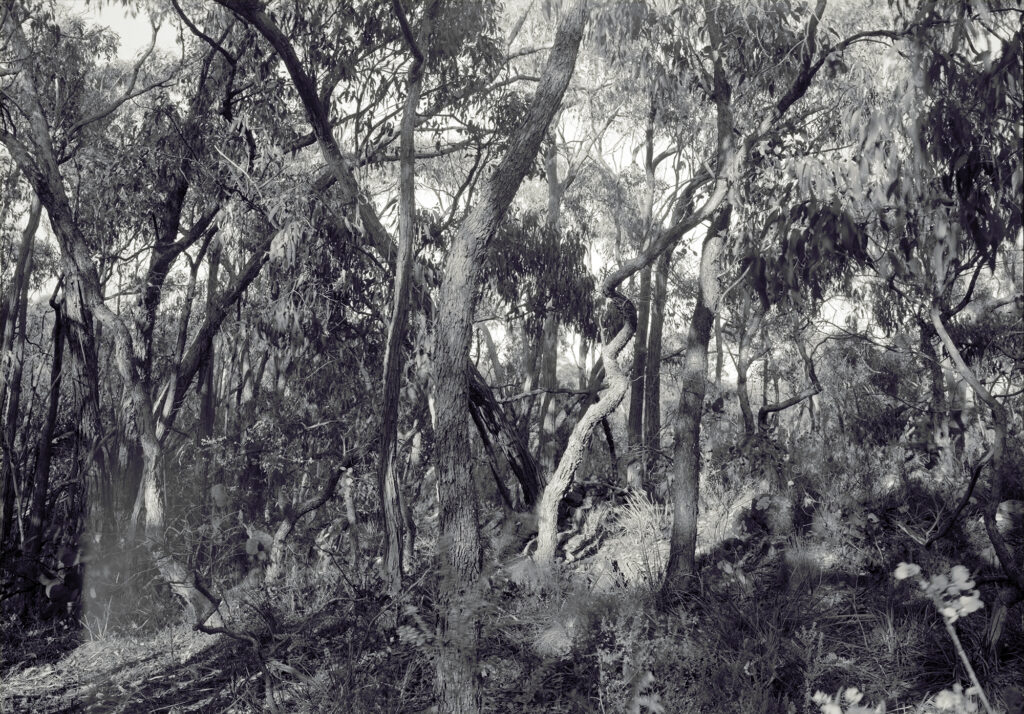
Post-processed scan of a 5 x 7 (12.7 x 17.7 cm) gelatin silver negative.
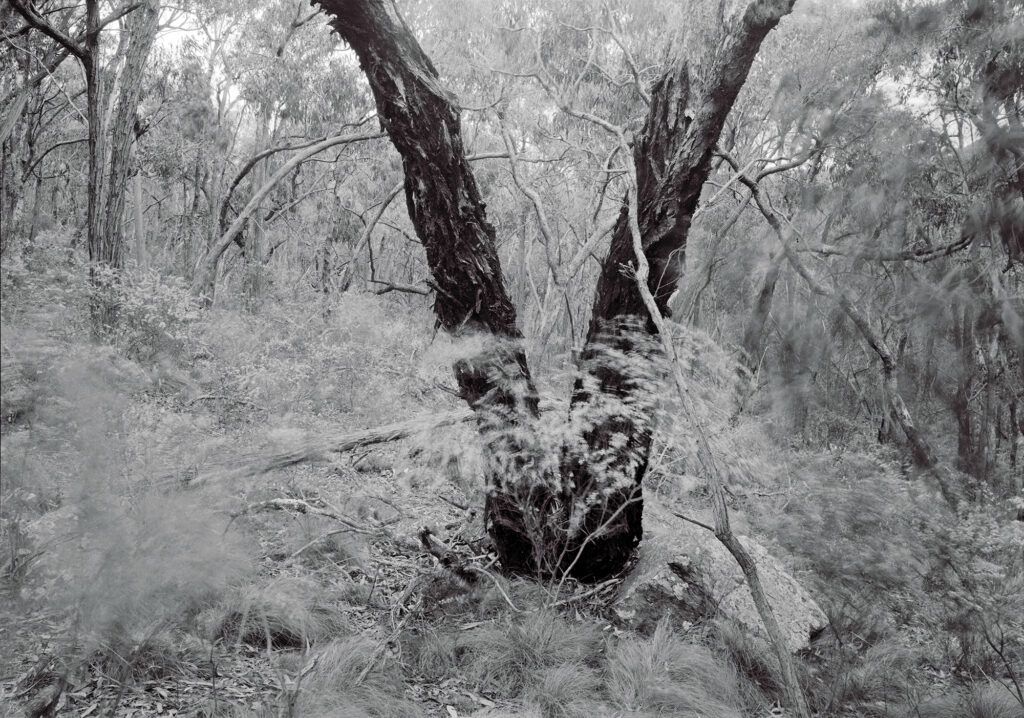
Post-processed scan of a 5 x 7 (12.7 x 17.7 cm) gelatin silver negative.
Next Post: Folio: Kiernan May
Previous Post: Ilford Pan F now in sheet film sizes

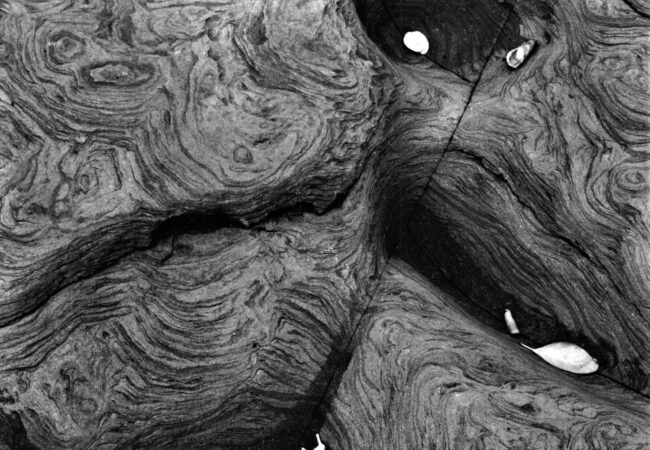

Thank you very much for this article Harry. Certainly an interesting and challenging landscape. I’ve always thought that the choice of Heritage in the Castlemaine Diggings National Heritage Park name unfortunate.
Very good to see your 5×7 photographs.
Thanks David.
I agree. Moreover, there’s a community lobby aimed at getting ‘World Heritage’ status for the goldfields region – not for its remaining natural values or indigenous pre-history – but for its extractive industrial history. Hmmph.
Best,
Harry
A great read Harry, and some thoughtful images to boot – I especially like your ‘Acts of Ritual 51’ where you have again used subject movement as an integral part of the narrative. There’s an almost electric atmosphere projecting from the bushland. I sympathize with your sentiment on how we each may reconcile an idealized concept of Nature with the compromised reality. It is a disparity that continues to drive me (quite literally) further and further away from our populated areas, and I must say not always with a sense of having overcome the problem.
Thank you, Murray.
Regards,
Harry